
7 classroom routines and procedures that save the first ten minutes
Every teacher knows the shape of the first ten minutes. The bell goes, thirty people arrive carrying coats and conversations, somebody needs a pencil, two students walk in late, and there’s a form from the office that needs signing before second period. Somewhere in there, the lesson is supposed to start.
Most advice treats this as a discipline problem. It almost never is. It’s a design problem, and the difference matters, because a discipline problem asks you to be firmer every day while a design problem asks you to make one decision and then stop making it.
Classroom routines and procedures are not about control. They are about removing decisions, so that the start of a lesson costs nobody any thought.
Below are seven routines that reclaim the start of a lesson, in the order worth building them. None needs a behavior system, a new curriculum, or anybody’s permission.
What the first ten minutes actually cost
The arithmetic is worth doing once, because it reframes the whole thing from an irritation into a budget line.
- 10 minutes a day across a 180 day year is 1,800 minutes
- That’s 30 hours, or roughly five to six full days of instruction
- For a secondary teacher with five classes, the same ten minutes per period is closer to 150 hours a year
Interruptions compound it, and there’s good research on how much. A 2021 study of Providence schools by Matthew Kraft and Manuel Monti-Nussbaum found:
- The typical classroom was interrupted 15 times a day
- That’s more than 2,000 interruptions over a school year
- High school students there lost the equivalent of 10 days of instruction to interruptions alone
- Achievement was lower in schools with more interruptions, and the researchers found no high-achieving schools with high interruption counts
That last finding is the encouraging one, as reported by Education Week. Interruption rates varied enormously between classrooms in the same building, which means they are a property of how a room is run rather than who is sitting in it.
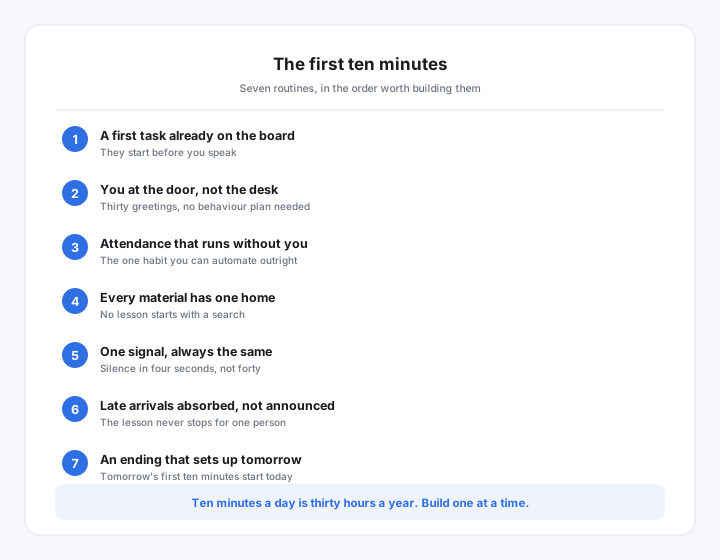
1. Put the first task where they can see it before you speak
The highest-leverage change on this list. Something on the board students can begin without instruction, visible from the door, running from the moment the first person walks in.
It doesn’t need to be elaborate. Three retrieval questions from last lesson, a problem to attempt, a sentence to correct. The point isn’t the intellectual content, it’s that arriving students have a default action that isn’t talking to their neighbour.
The three rules that make it hold:
- It goes up before the bell, every lesson, without exception
- It is genuinely independent. Anything needing you to explain it first defeats the entire purpose
- It is always in the same place on the board, so students look without being told to
You get a room that is already working while you deal with the pencil, the late arrivals and the form from the office.
2. Stand at the door, not at your desk
Greeting students at the door is the most recommended routine in this entire area, and it’s one of the few with a controlled study behind it.
Cook and colleagues ran an experiment across two middle schools with 203 students and 10 teachers. Teachers greeted each student by name at the door with a brief nonverbal greeting. The results:
- Academic engaged time rose by 20 percentage points
- Disruptive behavior fell by 9 percentage points
- Teachers rated the strategy feasible and reasonable to sustain, which matters more than the effect size does
Worth understanding why it works, because it isn’t only warmth. Standing at the door for ninety seconds is an intelligence-gathering exercise. You learn who arrived upset, who is carrying something heavy from the previous lesson, who is already looking for an argument, and who you need to intercept quietly. You collect that information now, privately, instead of discovering it ten minutes later in public.
It also puts you physically between the corridor and the room, which resolves a surprising number of situations before they enter it.
3. Make attendance happen without you

Of the seven, this is the only one you can remove from your morning outright rather than merely make faster. Which is why it deserves more attention than it usually gets.
Reading names aloud costs about four minutes once you include settling the room, working out whether an empty chair means absent or bathroom, and starting again after losing your place. Worse, it lands at exactly the moment you should be at the door, which puts habits two and three in direct competition for the same ninety seconds.
There are three ways out, in ascending order of setup:
Take it visually
A seating chart lets you mark a full class in about twenty seconds by scanning for empty chairs rather than reading a list. Our free seating chart and roster tool will make you one, and for a stable class this is often enough on its own. Free, no accounts, nothing to maintain.
Have students mark themselves on paper
A sheet by the door where students initial as they arrive. The attendance sheet generator prints a month with real weekdays and holidays already removed. It works, and the honest drawback is that somebody transcribes it later, so the cost is moved rather than removed.
Let the room record itself
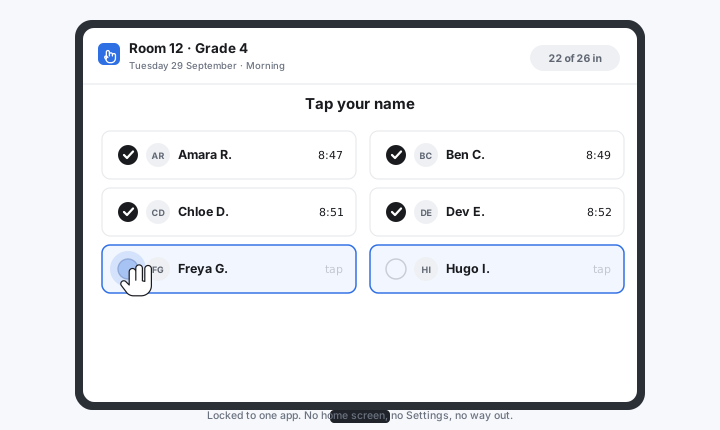
A tablet by the door showing the class list, where students tap their name on the way in. OneTap runs this way in any iPad browser, so each arrival is timestamped as it happens and you never open anything. Three things follow from that which the other two methods can’t offer:
- It survives a substitute. The screen is already showing the right class and the students know what to do
- Late arrivals land on your register from the front office without interrupting you
- The running total is current, so attendance percentages and the list of students approaching chronic absence exist without anybody calculating them
Whichever you pick, the test is the same: does the record get made without needing your attention during the exact ninety seconds you should be spending on people?
4. Give every material a permanent home
A lesson that begins with thirty people looking for something has already lost. Each of these needs one location that never changes:
- Whiteboard pens and spare pencils
- Calculators, rulers, glue, scissors
- Today’s worksheets, in a place students can collect from on the way in
- The tray for finished work
- Anything a late arrival needs to catch up
The failure mode here is subtle. Most classrooms do have a home for everything, but the homes drift across a term as things get tidied, and nobody announces the move. Two weeks later a third of the class is asking where the rulers are. Reset it once a term, deliberately, and tell students you’ve done it.
5. Use one signal, and always the same one
Whatever you use to bring a room back to attention, use exactly one, use it identically every time, and wait for full compliance before continuing.
A consistent signal becomes automatic, and an automatic response costs students no decision. A signal that varies, or that you talk over, becomes one more thing to evaluate: is she serious this time? That evaluation is what turns four seconds into forty.
The hardest part is the waiting. The first fortnight feels slower than raising your voice. It pays back within a month, and then every lesson after that.
6. Absorb late arrivals without stopping
A student arriving eight minutes late costs far more than eight minutes if the lesson stops to process them. The class turns, the thread goes, and everybody spends thirty seconds re-finding their place.
Decide the procedure in advance, teach it explicitly, and hold to it:
- Come in quietly, no greeting required from either side
- Put any slip on the corner of the desk
- Start the board task
- Ask a neighbour what page, not the teacher
- Anything that needs discussing happens at the end of the lesson, privately
That last point does more work than the rest combined. A conversation about lateness held in front of thirty people has almost no chance of changing anything, and it costs the room a minute. The same conversation at the door on the way out is both shorter and more likely to land.
7. End in a way that starts tomorrow
The final routine feeds the first. A consistent close means tomorrow’s start is already built:
- Materials go back to their homes, by students, not by you at 4pm
- The room is reset to its default layout
- Tomorrow’s board task goes up before students leave
The reverse is how most difficult mornings get made. A lesson that ends with the bell and a scramble leaves a room that has to be reconstructed before anything can happen the next day, usually by you, usually at 8:15.
Build one at a time, not seven
The most common way this fails is attempting all of them in the first week of September, which is also when you are doing nineteen other things.
A workable sequence:
- Weeks 1 to 2: the board task. Visible change on day one, requires nothing from anybody else
- Weeks 3 to 4: attendance, because it’s the only one you can hand to a system rather than to a routine
- Weeks 5 to 6: the door greeting, which is now possible because attendance stopped competing for those ninety seconds
- Then: materials, the signal, late arrivals, the ending, two weeks each
All seven are running by about half term, which is considerably faster than trying everything in week one and keeping none of it.
What it looks like after a term
The thing to watch for isn’t a quieter room, though that tends to follow. It’s the first morning you notice the lesson has started and you didn’t start it.
Students came in, saw the board, began working, marked themselves present, and you spent the first four minutes talking to the two people who needed talking to rather than performing administration at the front.
That’s what thirty hours a year looks like when you get it back. Not a transformation, just a lesson that begins on its own while you do the part only a person can do.
Frequently asked questions
What are classroom routines and procedures?
The fixed ways a class handles recurring moments: how students enter, how attendance is taken, where materials live, how you call for attention, what happens when somebody arrives late. They differ from rules in that they describe process rather than behavior, and they work by becoming automatic rather than by being enforced.
How long does it take to establish a classroom routine?
Roughly two weeks of daily, identical repetition before it stops requiring attention from either side. The most common reason classroom routines and procedures fail is introducing several at once, or applying them inconsistently in the first fortnight, which teaches students the routine is optional.
What is the most important routine to start with?
An independent task visible on the board before the bell. It changes the first two minutes of every lesson immediately, requires nothing from anyone else in the building, and makes every other routine on this list easier to run.
How can I take attendance faster?
Three options in ascending order of setup: mark it visually from a seating chart, have students sign themselves in on a sheet by the door, or use a class attendance app where students tap their name as they arrive. The first takes about twenty seconds; the third removes the task from your morning entirely.
Does greeting students at the door actually work?
Yes, and unusually for classroom advice there’s a controlled study. Cook and colleagues found academic engaged time rose 20 percentage points and disruptive behavior fell 9 percentage points when teachers greeted students by name at the door.
How do you handle late arrivals without disrupting the class?
Teach the procedure explicitly: enter quietly, leave any slip on the desk, start the board task, ask a neighbour for the page. Anything needing discussion happens at the end of the lesson in private, where it is both less disruptive and considerably more effective.
Do these routines work in middle and high school?
Yes, and the case is stronger, because you repeat the start of a lesson four or five times a day. Ten minutes recovered per period compounds far faster on a secondary timetable than in a single homeroom.